
About this discussion paper and how to use it
SAGE is co-designing a dedicated gender equity, diversity and inclusion (GEDI) accreditation program, purpose-built for the Medical Research Institute (MRI) sector.
This paper is an invitation for the MRI sector to collaborate with us. Our consultation has a specific objective: to test and refine the program structure and delivery model, to ensure it works for you and your organisation.
Outlined below, is an early-stage draft of a program structure. We invite you to review it and tell us whether:
- it makes sense
- it would work in your organisation
- anything needs to change.
Your input will directly shape what gets built next.
A new SAGE GEDI program — why now?
The purpose of this program is to bring cohesion to your existing GEDI work. By unifying these efforts into a single national accreditation pathway, the program aims to build safe, fair, and inclusive research and working environments. The need for this program is timely, with GEDI requirements growing, and the Women in the Health and Medical Sciences Decadal Plan by the Australian Academy of Health and Medical Sciences naming SAGE as a key delivery partner in its strategic recommendations.
What we learned in the discovery phase
We engaged with nearly 100 representatives from over 40 MRIs, peak bodies, funders, government departments, and international partners.
From the outset, the message from the sector was clear. MRIs want a program that:
- reflects how they operate, with a cohesive, whole-of-institution approach
- aligns with existing reporting requirements
- balances structure and flexibility.
Read more about what we learned in the Discovery Phase.
*The content below is also available as a downloadable Word document: MRI Discussion Paper_accessible
An umbrella program for MRI GEDI efforts
Most GEDI programs stop at diagnosis. They tell you what the problem is but not what to do about it. What we are proposing goes further: a complete pathway from self-assessment to action to evaluation to recognition, and then back around again, each cycle building on the last.
This isn’t just another accreditation program to add to the work and commitments you already have in this space. Our model seeks to:
- Utilise your existing GEDI work, such as action plans and internal initiatives
- Consolidate your GEDI work into one program
- Adapt to your context, including legal or reporting mandates.
The proposed six-step continuous improvement cycle
Organisations move through six steps delivered through a guided online platform. Each of the six steps are described below.
Support from the SAGE team and the MRI program Community of Practice (CoP) would be available at any point throughout the cycle. SAGE would step in at two defined points: after Assess to review the self-assessment and issue a maturity award, and after Design to review action and evaluation plans and provide developmental feedback before implementation begins.
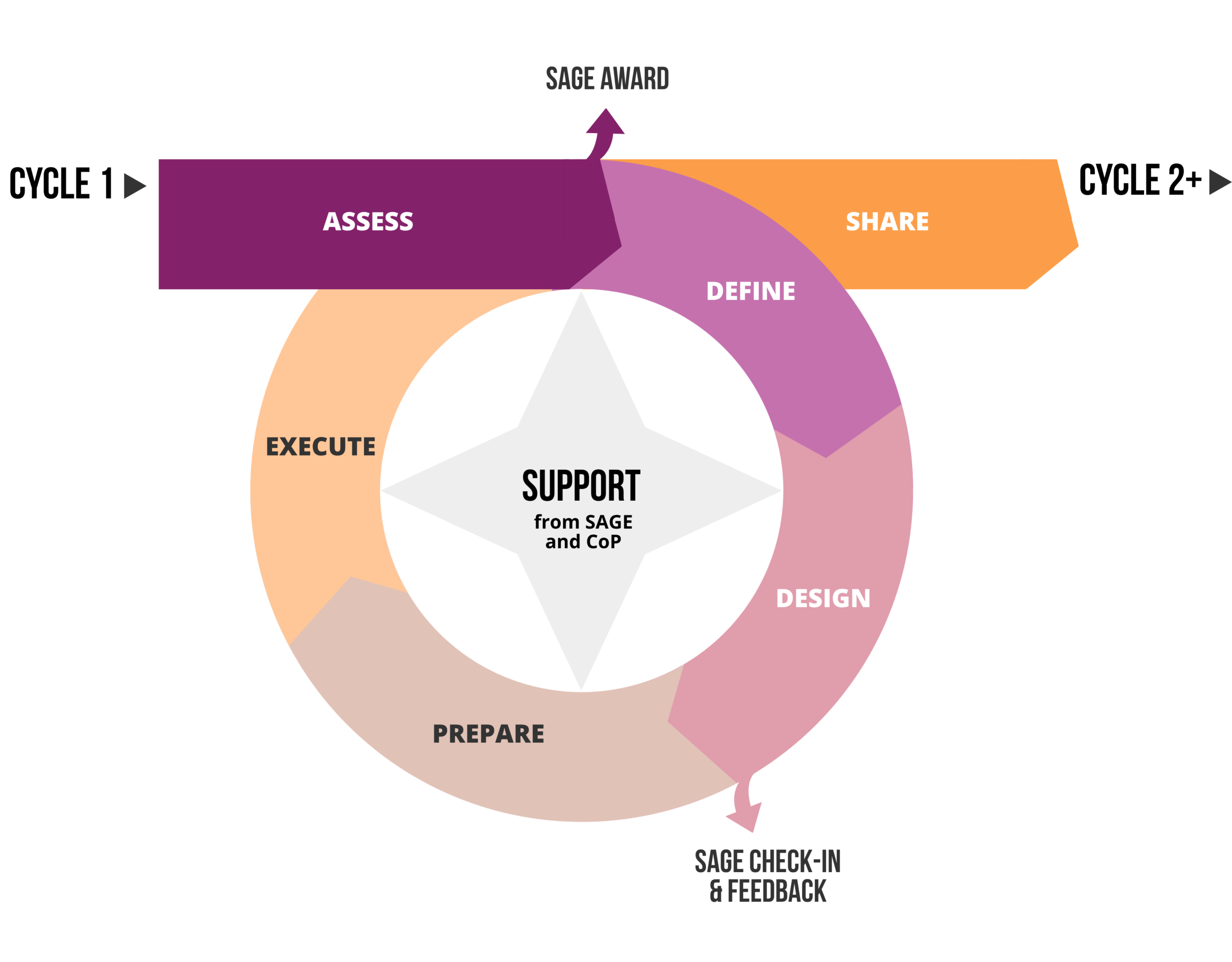
Note: Joining the program involves an onboarding process including a membership agreement and leadership commitment. This onboarding process would sit before the cycle begins. It is not shown in the diagram above.
The delivery model and features
The six-step cycle is delivered through a single, low-burden, user-friendly online platform. The platform is designed to be accessible throughout: providing information in multiple formats, reducing cognitive load by breaking work into clear, structured sections, and supporting people from non-English-speaking backgrounds.
The sections below describe what each step involves and the features we are proposing for each.
1. Assess
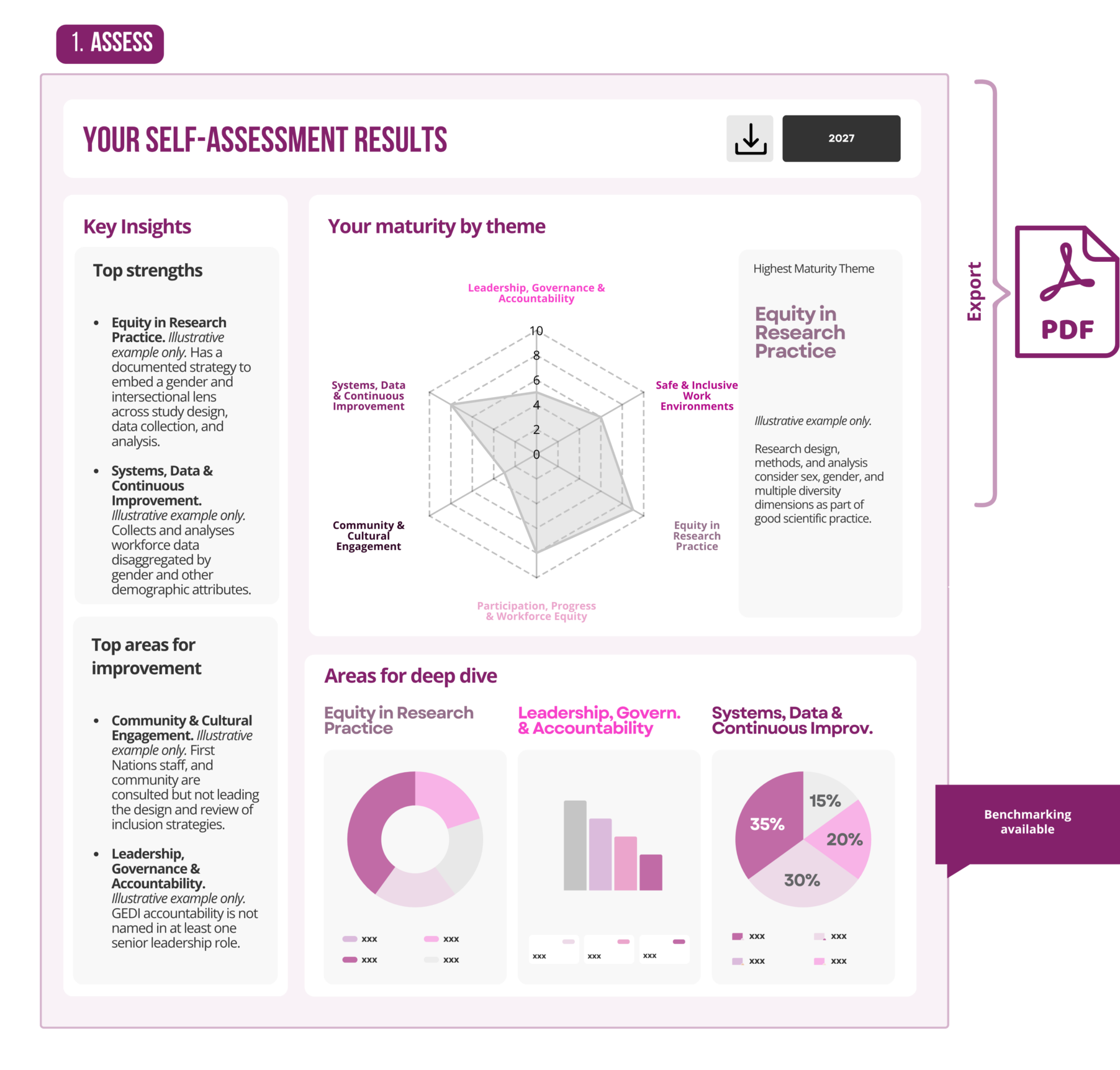
The Assess step is designed to begin with a guided online self-assessment with structured questions, and selectable options to help organisations identify and prioritise their GEDI barriers to address. The intention is that organisations are not starting from scratch: some data will autofill for users to validate and fill in any gaps, reducing the time and effort required.
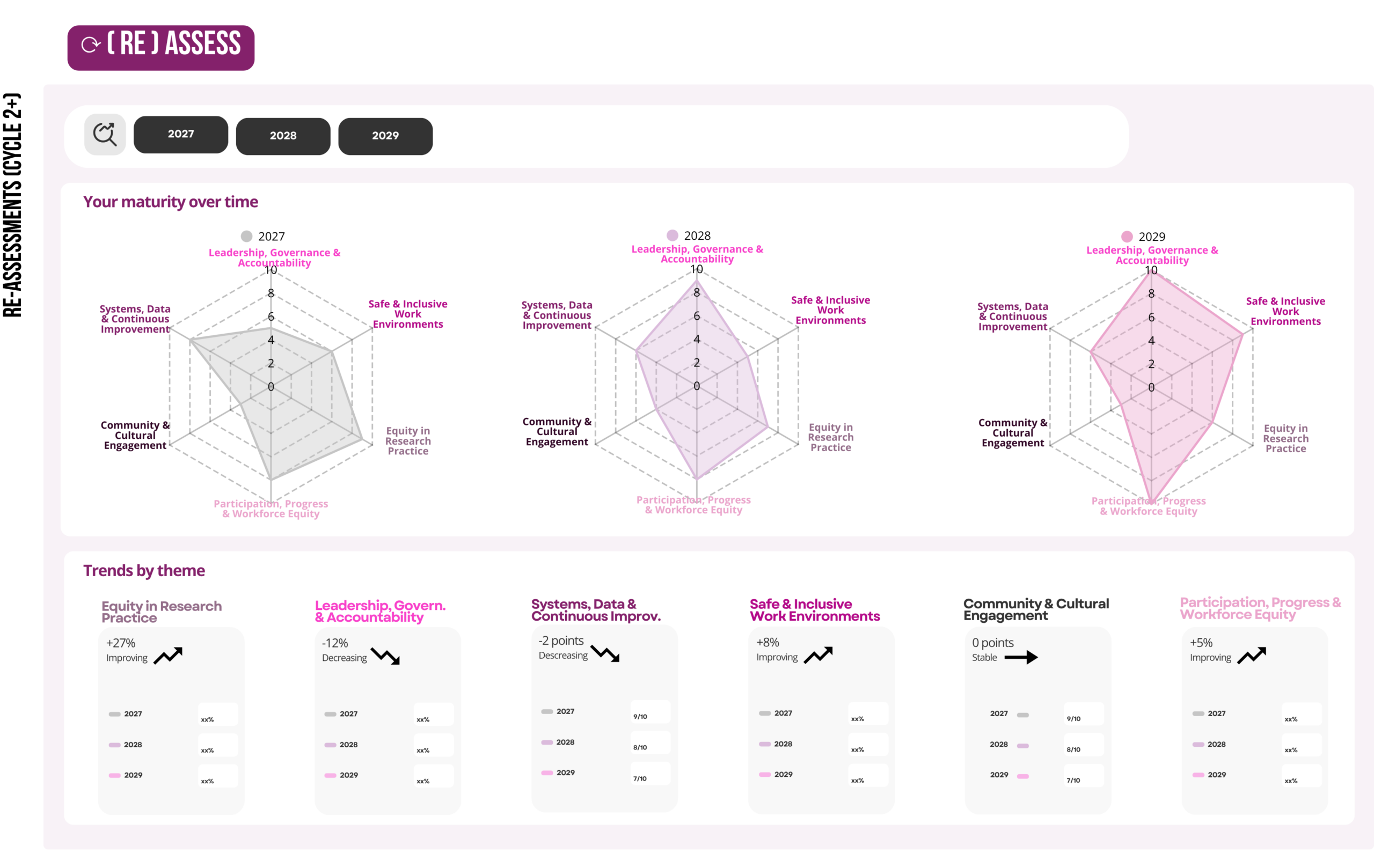
We are proposing that the self-assessment produces a results dashboard showing an organisation’s GEDI maturity by theme, top strengths, and priority areas for improvement. Over multiple program cycles, the dashboard would show trends and changes to your organisation’s maturity over time (See the re-Assess section below). The example below illustrates what this could look like.
Proposed features include:
- The ability to upload your existing GEDI work (e.g. action plans and strategies), so it directly informs your assessment, results, and next steps
- Autofill, with fields pre-filled from your uploaded documents and/or earlier answers, ready for you to confirm or edit
- A dashboard that summarises your data to help you interpret the results
- Benchmarking your organisation’s results against national sector averages.
Fig. 2. Illustrative example of the self-assessment results dashboard.
2. Define
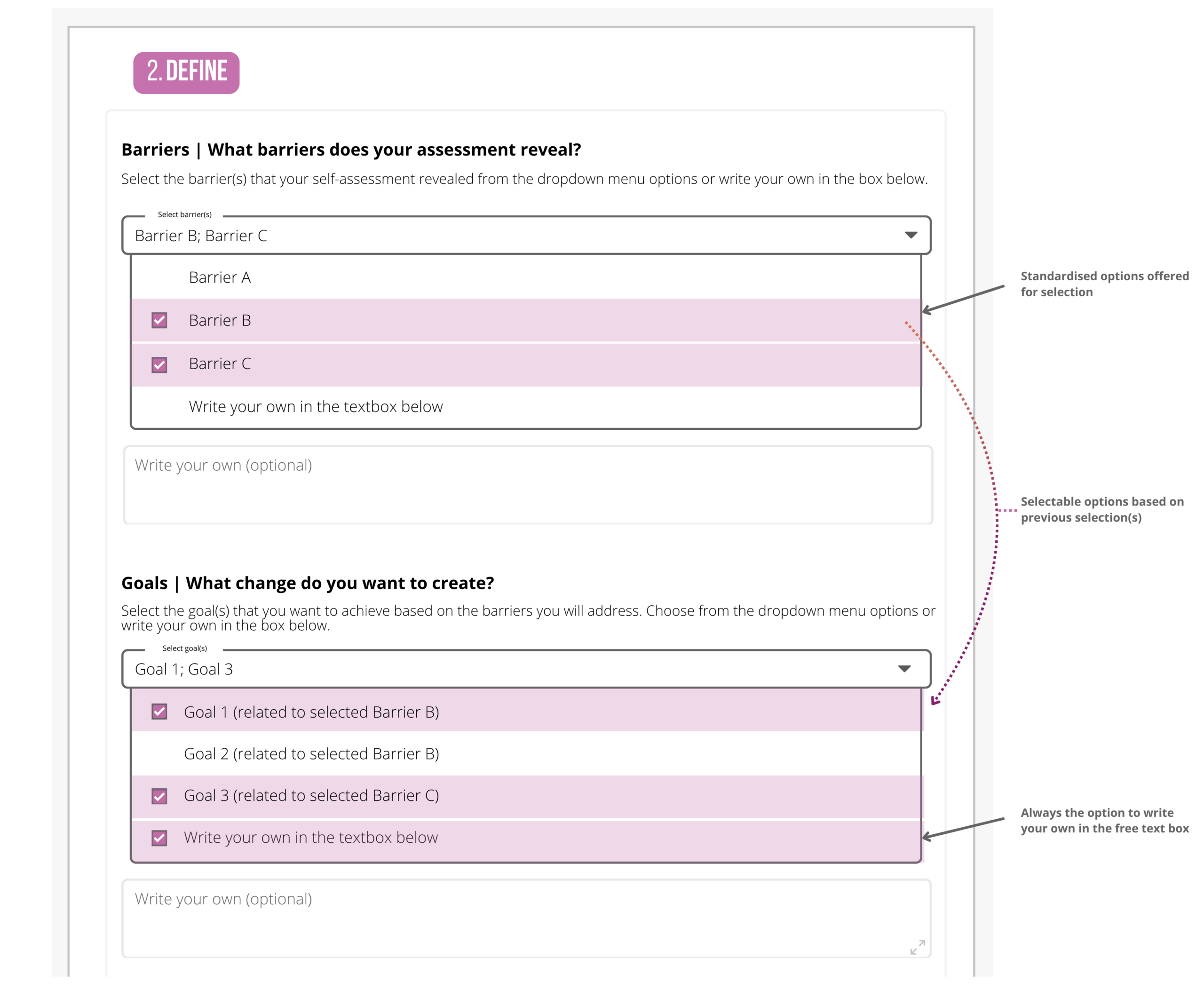
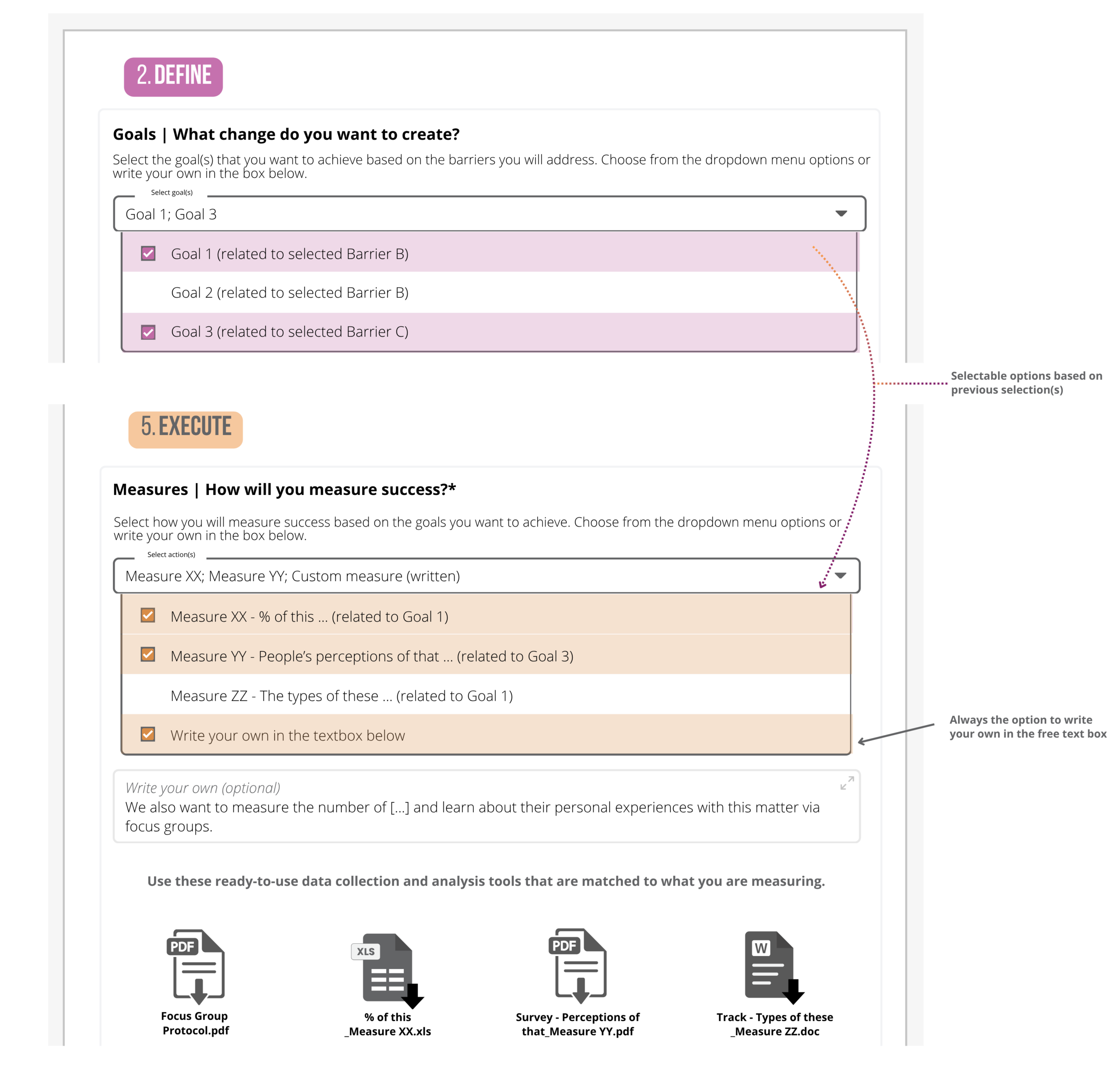
In the Define step, the platform is designed to guide organisations through identifying which barriers to prioritise based on the dashboard results. For example, the dashboard will identify your organisation’s top areas for improvement. These results help you define which barriers you want to focus on and set goals for your organisation to drive genuine change.
Proposed features include:
- Autofill, with fields pre-filled from your earlier answers
- Prewritten, selectable options (such as barriers and goals) tailored to what you have already chosen, with an option to write your own.
3. Design
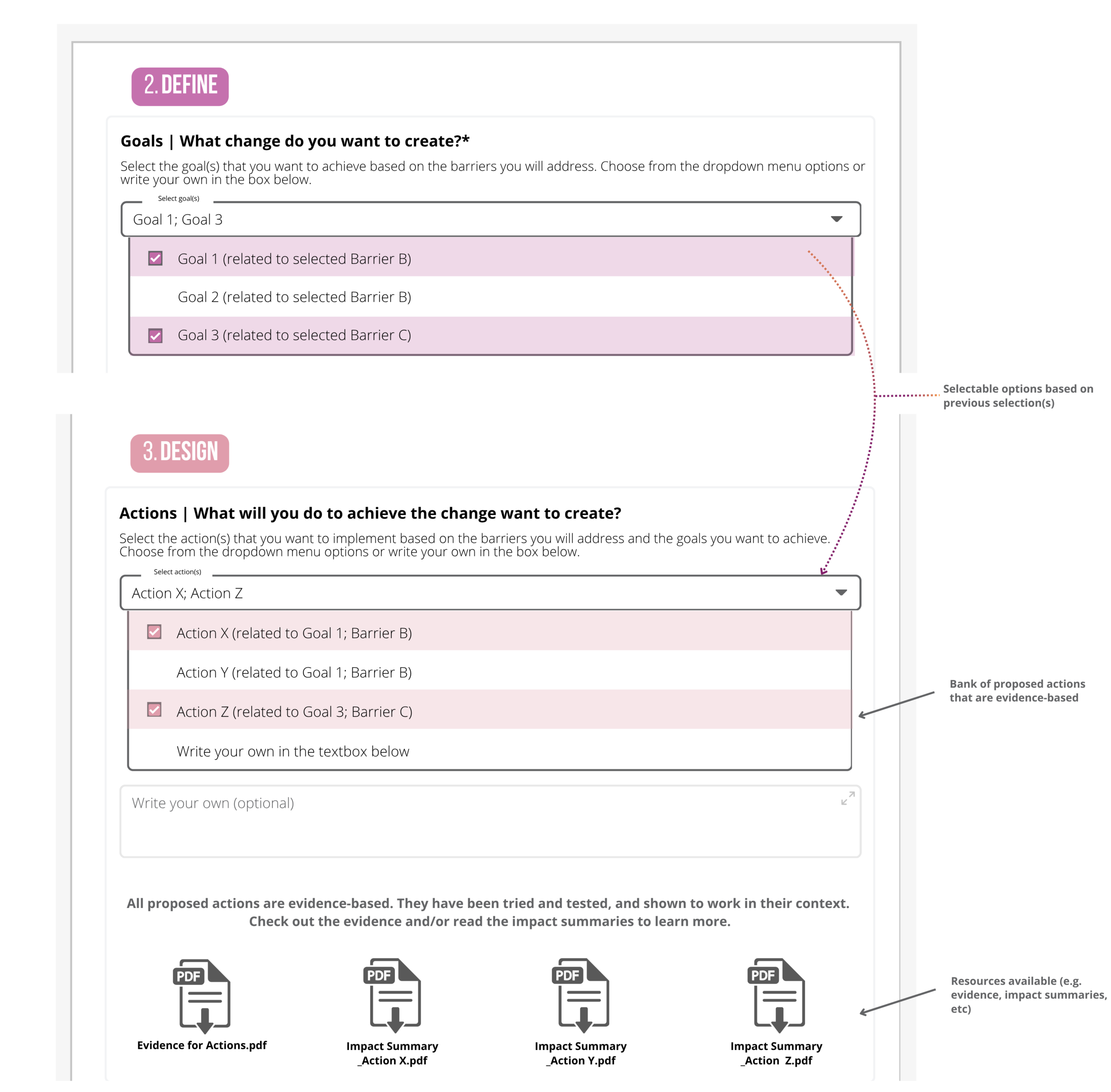
In Design you build an action plan. This is where we are proposing the program goes beyond diagnosis. We are envisaging a bank of evidence-based actions drawn from research and ten years of what SAGE members have implemented and found to work in Australian research settings, with case studies showing how specific actions have been put into practice. It prioritises actions that shift systems, processes, and practices. The intention is that you are not reinventing the wheel. You are choosing from a bank of initiatives that have worked and adapting it to your context. This helps MRIs make easier and faster decisions while gaining high-quality outcomes.
Proposed features include:
- A bank of evidence-based actions to select from, matched to the barriers and goals you have identified, drawn from what has worked in practice
- Downloadable SAGE member impact summaries showing how actions have been implemented, and their outcomes and impacts, to inform your choices.
4. Prepare
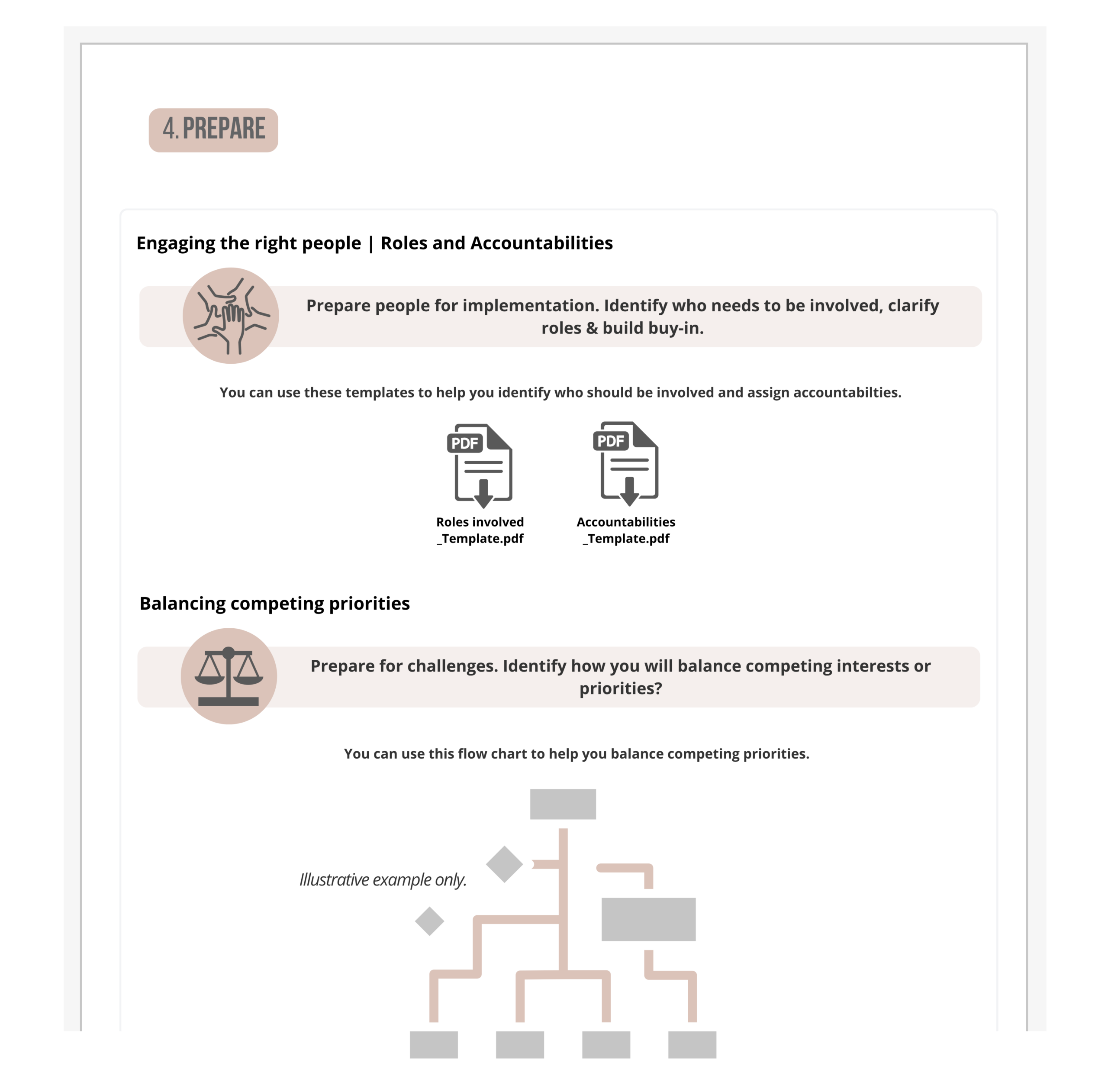
In Prepare the platform is designed to guide your organisation through readying for implementation. This includes identifying who needs to be involved, their roles and accountabilities, and working through what it will take to bring your plan to life: engaging the right people across the organisation, fitting new actions into existing processes, balancing competing priorities, and planning ahead for challenges along the way.
Proposed features include:
- Templates and tools to help you plan the practical side of implementation
- Guidance to help you prepare for challenges, balance competing priorities, and bring the right people on board.
5. Execute
In Execute, you put your action plan into practice. Evaluation is built into this step, not added on afterwards, so you can monitor if your actions are working and measure any outcomes and impact as you go. We are proposing practical, ready-to-use tools to help you decide what to measure, the right data to collect, and how to make sense of it. Importantly, this goes beyond numbers and metrics: the aim is to help you also capture the human stories, and the cultural shifts that show whether your GEDI work is making a real difference.
Note. Individual-level data stays with your organisation. What flows to SAGE is anonymous, summarised data only. Over time, national participation in the program will build a consistent, comparable GEDI evidence base across the MRI sector.
Proposed features include:
- Prewritten, selectable suggestions for what to measure, tailored to the goals you set in Define, with options to write your own
- Ready-to-use data collection tools matched to what you are measuring (e.g. focus groups protocols, surveys)
- Built-in tools to analyse your data and summarise your results.
6. Share
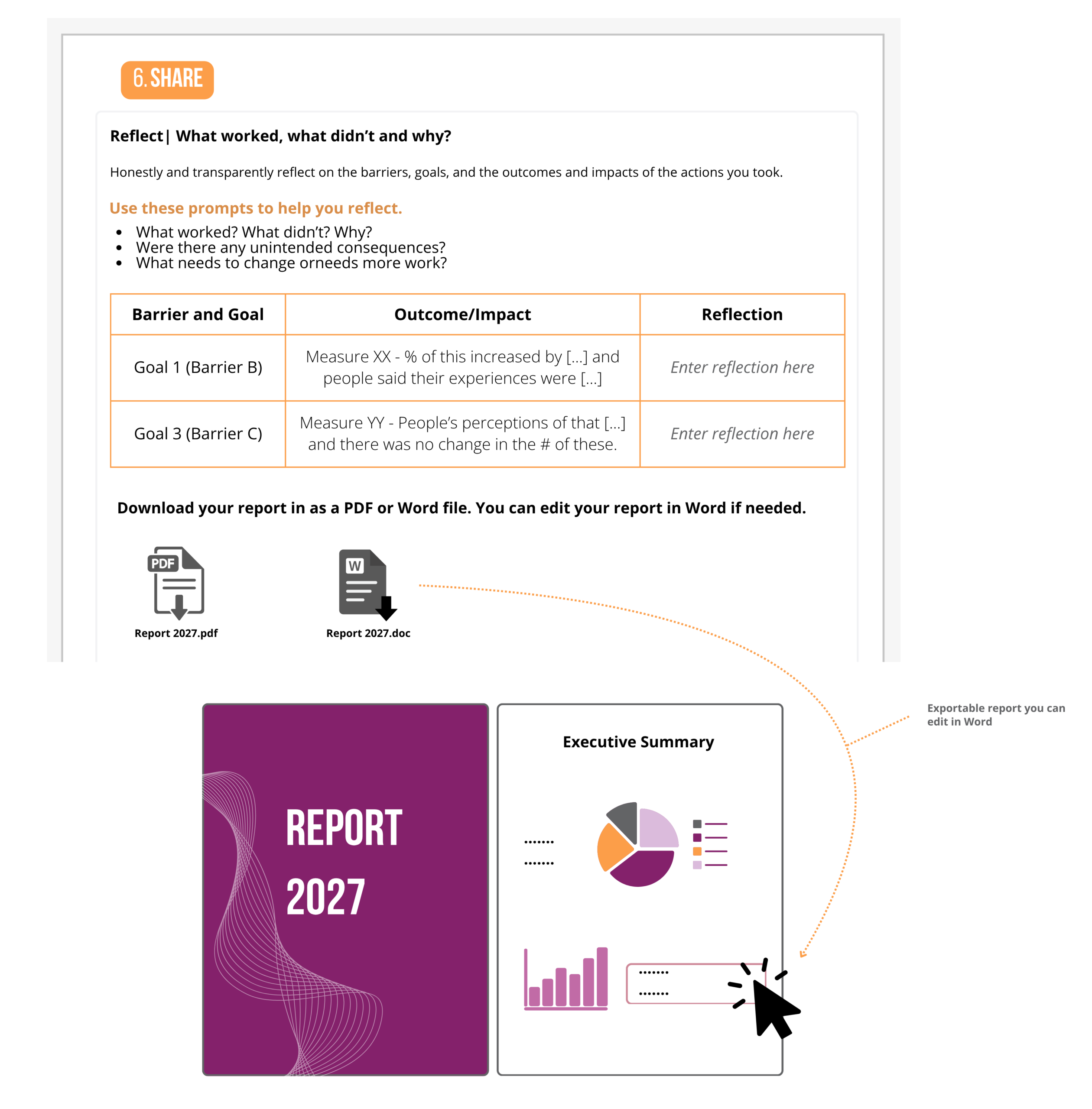
In Share, you report your findings transparently to your organisation, SAGE, and the sector. This step is about honesty and self-reflection as much as it is about reporting: sharing what worked and what didn’t, not just the highlights.
Proposed features include:
- An editable, exportable report you can download and share
- Prompts to help you report honestly and transparently
- Guidance on communicating your results to different audiences, such as academic and professional staff, partners, government, boards, funders, or students.
⟳ (re)Assess
Each cycle is designed to build on the last. From cycle two onwards, you complete the same structured self-assessment again, so your results can be compared directly against your previous assessment. This shows you how your organisation has changed over time, and gives you the opportunity to be recognised with an updated maturity award from SAGE where standards have been met or exceeded.
The proposed maturity award and a clear path forward
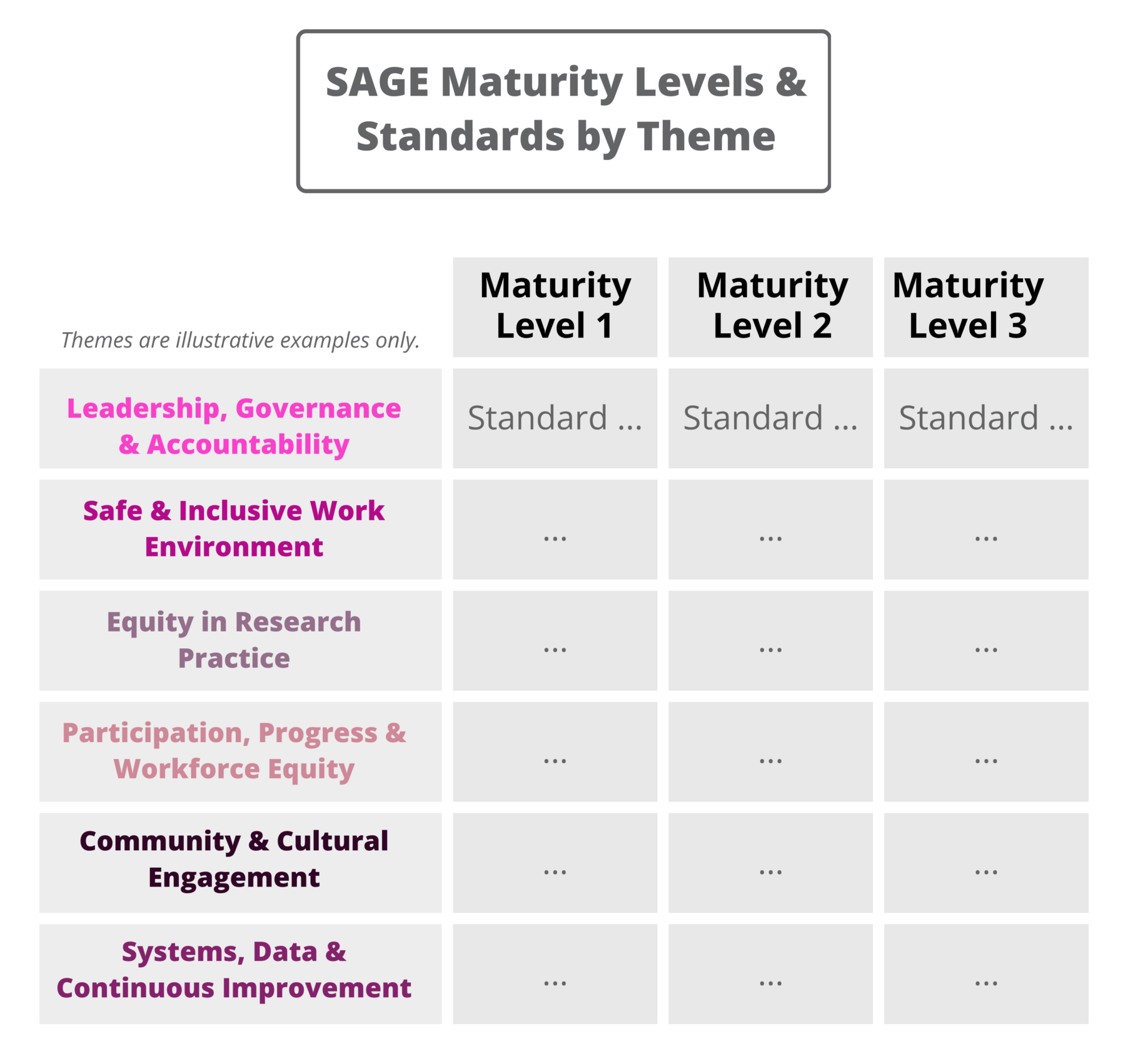
We propose that, at defined points in the cycle, SAGE reviews the completed work and issues a maturity-level award. The number of maturity levels, their names, and the requirements they entail will be co-designed with the sector in 2027/28.
The intention is that the award reflects where an organisation is on its GEDI journey, assessed against a set of clear, pre-established standards. Specific standards would be described at each maturity level, so organisations can see exactly what is expected, what evidence is needed, and what the next level of maturity looks like. That transparency is intentional, to provide a clear, achievable path forward. The example below illustrates what this could look like.
Proposed support throughout the cycle
SAGE support and resources are proposed to be available at any point throughout the cycle, not just at the two defined touchpoints. This would include access to SAGE experts, ten years of SAGE member resources, guidance developed specifically for the MRI context, and a sector-specific Community of Practice where MRI GEDI practitioners can share knowledge, solve problems together, and learn from what is working across the sector. SAGE acts as a ‘critical friend,’ providing guidance and constructive, honest feedback to support your organisation’s GEDI growth and improvement.
Ready to share your feedback?
Our survey takes about 15 minutes. Responses are anonymous and findings are reported in aggregate. The survey closes on Friday 11 September 2026 at 11.59 pm AEST.
Prefer another way?
We want this consultation to work for everyone. You can also:
- Talk to us. Request a phone or video call, or send a voice recording, and we’ll capture your responses.
- Write to us. Email your feedback in whatever form suits you.
Contact Isabelle Kingsley at sage@sciencegenderequity.org.au.
Want to prepare first? Download the survey questions (SAGE MRI Consultation Survey_accessible) to read over, talk through with a colleague, or jot down your thoughts beforehand.
Invited to a roundtable? The SAGE team will email you the discussion points. You don’t need to complete the survey.

This work is part of the Science in Australia Gender and Equity Framework (SAGE Framework) project, funded by the Australian Government’s Department of Industry, Science and Resources.
FAQs
What is the purpose of this project?
Who will be involved?
What is the commitment?
What impact will this project create?
Recent Updates






Join our mailing list
Enter your email
Full access to our website is limited to our subscribers.
If you are a staff member or student at a SAGE subscriber institution, please enter your institutional email address.
If this is the first time you are logging in, verify your email via the link sent to your inbox.